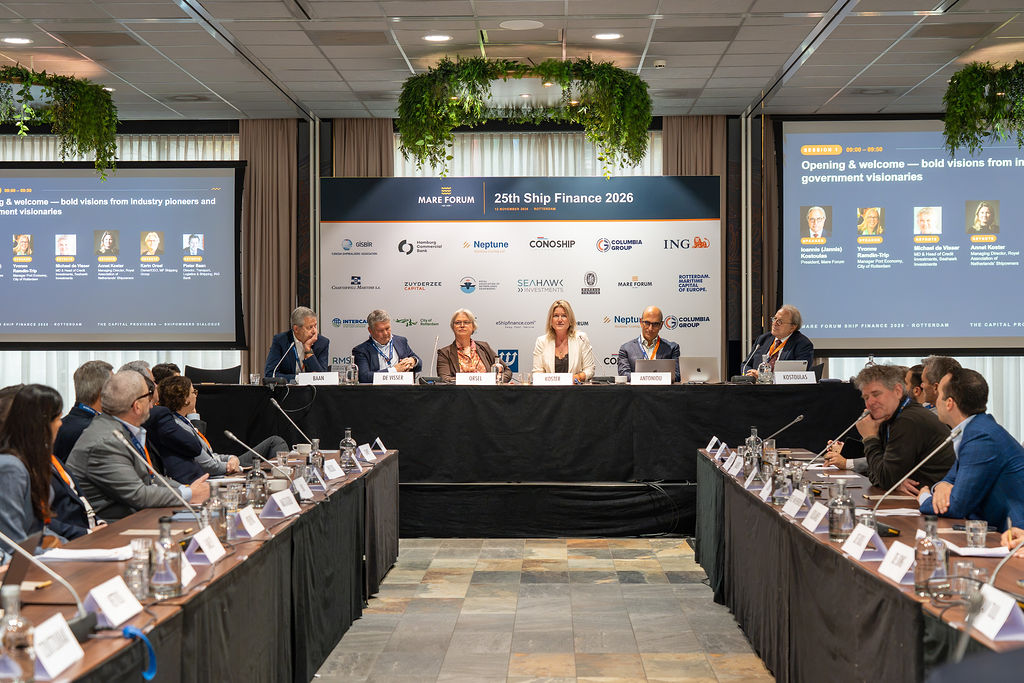
Rotterdam, 12 November 2026 — Twenty-five years after the first edition met in Amsterdam, six weeks after 9/11, bankers, lessors, funds, owners, shipbuilders, insurers and policymakers filled the Haven Hotel on the Leuvehaven for the 25th Mare Forum Ship Finance. The questions were the ones the forum has asked since 2001: where does the money come from, who carries the risk, and which ships should be built for the next 25 years?
This year the answer to the first question was easy. There is more capital chasing ships than at almost any point in living memory. The harder questions were whether that capital is still disciplined, who pays for a transition whose fuels do not yet exist at scale, and why Europe keeps paying for ships, fuels and technologies that are built elsewhere.
A quarter of a century
President Ioannis (Jannis) Kostoulas opened with the forum’s origin story. In October 2001 events everywhere were being cancelled and planes flew half empty. “We had a choice: play safe or cancel. We pressed on.” Owners and bankers flew in from abroad, and the first edition became “not just a conference, it was a statement.” Since then Mare Forum has travelled from Houston and Athens to Rio, Tokyo and Hong Kong, but Rotterdam, “a city that was flattened and rebuilt itself… a city that doesn’t talk, it works,” is home.
He set the day’s brief in four questions. Who finances the zero-carbon fleet? Who carries the technology risk? How do you price a ship whose fuel does not yet exist at scale? Are the banks coming back, or have some left for good? “I expect your speakers to give straight answers, not polite ones.”
“When the weather turns, you don’t abandon ship. You keep sailing.”
Ioannis (Jannis) Kostoulas, President, Mare Forum
Yvonne Ramdin-Trip, Manager Port Economy at the City of Rotterdam, welcomed the forum back to “the maritime capital of Europe” and asked the room to think as “Team Europe”. The port cluster has all the cards, she said, but its position “is not a given anymore”, and the transition has to be financed together.
This time is different?
Michael de Visser, Managing Director and Head of Credit Investments at Seahawk Investments, gave the keynote that the rest of the day kept returning to. Ship finance was once “largely a banking story” — ABN AMRO, ING, Rabo, NIBC, Fortis, DVB. Today banks share the field with lessors, private credit, institutional and bond investors. “The financing spectrum has never been broader.”
Taken one by one, the signals are unremarkable: a record order book in absolute terms, newbuilding slots at leading yards sold out four or five years ahead, an active Nordic bond market, and a $1 billion syndicated facility heavily oversubscribed at around 150 basis points. Taken together, they tell a story of optimism and liquidity — and he reminded the room what was said before 2008. “The mistake was not the story. The mistake was believing that a powerful story somehow reduced the need for discipline.”
Today’s strength, he argued, rests partly on inefficiency: longer routes, rerouted cargoes and sanctions mean “the same cargo is simply travelling further”. And capital does not only follow values, it makes them. If lenders would finance only 30–40% of a $100 million ship, would that price even exist? “Then everybody in this room plays a role.”
“Are we building ships for structural demand, or for temporary inefficiency? Inefficiencies can disappear much faster than the ships.”
Michael de Visser, Seahawk Investments
His closing question — can we stay disciplined “when the fear of missing out becomes stronger than the fear of getting it wrong?” — got its sharpest answer later from ING Research’s Rico Luman. Asked by the moderator whether trade patterns would return to normal once the wars end, he said: “This time is different. I’m sure about that.”
One ship, one year, €1.3 million
Annet Koster, Managing Director of the Royal Association of Netherlands’ Shipowners (KVNR), opened with arithmetic. A ship slightly bigger than an average coaster burns 20 tonnes of fuel a day, about 62 tonnes of CO₂. At an ETS price of around €88, that is more than €5,000 a day. Over 250 sailing days: “One ship, one year, €1.3 million.”
Dutch short-sea fleets are on average 10 to 20 years old, and about 75% of KVNR members expect their fleets to grow over the next five years. That means financing renewal and transition at once, with owners choosing between methanol-ready, ammonia-ready, battery-hybrid or simply maximum efficiency while the fuel market of 2035 is unknown. New technology raises capex, fuel uncertainty clouds opex, residual values are harder to call, and charterers want green transport but will not always sign long contracts or pay the premium.
“We want innovation, but we often finance familiarity.”
Annet Koster, Managing Director, KVNR
Her answer was the ETS itself. Revenue raised from shipping should flow back into shipping — not as compensation for emitting, but as targeted support: contracts that close the gap between conventional and clean fuels, guarantees for first-of-a-kind vessels, shoreside infrastructure and temporary operating support. “Public money should not replace private money, it should make private money brave enough to move.”
The European Commission has proposed returning 50% of ETS revenue to the sector, and the European Parliament has mentioned 70%. “The problem is here. It’s here in the Netherlands, it’s with the member states.” She asked the room to lobby with KVNR at national level, because the real barrier for a greener ship is “not solely the capex… but especially the opex, and the availability of the greener fuels.”
Karin Orsel, CEO of MF Shipping Group, promised a lighter touch and delivered a candid one. Finance is not the biggest challenge for owners any more; regulation and the IMO are. Nobody knows the fuel of the future — “it’s a crystal ball” — so the wise owners plan for replacement, not for “bigger, biggest”. The Netherlands, she said, is “more Catholic than the Pope” in wanting to lead on legislation, and owners bear the consequences when the rest of the world moves differently.
“It’s our seafarers who are in the front. They are the first ones who represent us and are being punished for simply doing their job.”
Karin Orsel, CEO, MF Shipping Group
Speaking for the sponsors, Pieter Baan, Director Transport, Logistics and Shipping at ING, called the forum “the annual reunion” of Dutch and international shipping. The Middle East had so far helped rather than hurt the market: fuel kept flowing at higher prices, container lines earned well, tankers became floating storage, and order books for large container ships and tankers are “higher than ever”. What happens when the war ends, the Houthi disruption subsides and Suez is fully used again? “Are we perhaps making the same mistakes as we did in 2006–2007?” Short-sea and feeder fleets are old and must be replaced, newbuilding prices are well above pre-COVID, and the industry is “simply no longer used to” today’s interest rates. “Which of today’s solutions will still make economic sense for tomorrow?”
The global game shift
Harris Antoniou, founder of Neptune Maritime Leasing, opened the first panel with a new competitor for shipping’s capital: artificial intelligence. AI spending is estimated at around 800 billion a year, against a global shipping order book of about 600 billion. On a recent visit to Taiwan, he said, roughly 80% of the banks told him they were closed for shipping loans for the rest of the year and perhaps the first quarter, because the money had gone to AI infrastructure. “Shipping now competes with AI.” Yet according to a BCG report he cited, 70% of shipping companies still track fleet performance with noon reports.
He turned Koster’s number around. One ship, one day, $1.3 million is roughly what a VLCC could earn on the Hormuz run. Meanwhile 40–45% of newbuilds, including some 40% of VLCCs, are dual-fuel despite the absence of an IMO net-zero framework. And European owners, with about a third of the world fleet, order their ships abroad: “European owners order the ships, but Asians get the benefit of it, because 93% of what we order goes to Asian yards.”
Luman described a year of 6% growth in global trade, far ahead of WTO and IMF expectations, driven by China’s export push to other regions as the US turned protectionist — and US imports have since rebounded anyway. The imbalances are growing: Europe now imports more Chinese cars than it exports, yet depends on China for rare earths. “How do you deal with that? I don’t know, actually.”
Dagfinn Lunde, chairman of eShipfinance.com, said there is “enough money for any ship you want to build at the moment.” Sanctions had been good for the product-tanker owners left in the legitimate market, but Europe’s industrial base is eroding under energy prices far above America’s: “good for shipping, but horrible for Europe.”
Made in Europe, or made by Europe?
Koster warned against Europe wishing itself a Jones Act. Some 94% of ships are built in Asia, and many “European-built” vessels come from European yards with facilities outside Europe. “If we fully focus on only made in Europe, it’s the beginning of the end.” Luisa Puccio of the European Shipowners (ECSA) argued for “made with EU”. Nobody thinks big shipbuilding can be repatriated, she said, but Europe still leads in clean technologies, and the ETS revision’s investment mechanism should be widened beyond fuels to clean engines and energy efficiency — “low-hanging fruit”. ETS money should also go partly to fuel suppliers, “to create a market”, with a bonus for fuel produced in Europe.
From the floor, Conoship’s Jan Jaap Nieuwenhuis said Chinese yards are automating so fast that in ten years labour will no longer decide the price of a ship; Europe could do the same, if it finds the money and the guarantees Chinese yards offer. “If we wait ten more years, we’ll be gone.” Kommer Damen, chairman of Damen Shipyards Group, answered from the floor that labour in China costs about a fifth of Europe’s and that bringing mainstream cargo shipbuilding back is “an illusion”: specialised and naval work stays, tankers and container ships will not return “in my lifetime, and also not in your lifetime.”
Mare Straetmans, founder of Platform Zero, recalled the investor day of an Italian electrolyser scale-up where about 80% of the room were Chinese investors. “Europe was not to be found.” What keeps technology in Europe, she said, is simple: “investment or clients.” Asked what really blocks the recycling of ETS money, Koster did not hesitate: “First of all, it’s the Dutch government… It’s free money for the Dutch government.” Dual-fuel owners are not burning clean fuel, and even biofuel bought from abroad is not always what it claims. Dutch owners, KVNR data shows, will pay up to 10% more for a European-built ship, but no more — and much of their newbuild finance is Asian. “We have a red carpet in Asia for financing newbuilds.”
The parallel fleet comes in from the cold
Antoniou had just returned from Dubai, where the two largest ship recyclers told him they had US clearance not only to scrap sanctioned tankers but also to trade them. Would anyone finance them? De Visser said the flag of the yard does not matter, liquidity does: “If an owner defaults, you want to make sure that this ship is able to be operated by somebody else, and not that it’s a stranded asset.” In the end, “you finance an owner.”
Bureau Veritas’ Steven Grotsky said class societies are now being approached “semi-frequently” about such ships. A 20-year-old tanker would not be disqualified automatically, but neither would it be accepted on paper: pre-class inspections, statutory work and a hard look at management commitment come first. “They need to say what they do and then do what they say.”
Urs Dür of Marsh said ships with serious OFAC problems will not be financed or insured in the West. Marsh has built what he called “effectively a private ECA”, non-payment insurance for lenders that is already live on several deals, and he sees short-sea projects with long charters where an insurance-backed solution competes directly with Chinese lessors. “We still have to underwrite as if we were a bank. We can’t be looking at ridiculous residual values.” The same structure, he said, could refinance perfectly good five- and ten-year-old ships for retrofits at European yards.
Philip Ponsford, Managing Director of Astaara Risk Management, called cyber “a huge shipping risk that is so ignored”. GPS in parts of the Gulf is close to unusable, standard hull cover excludes cyber, and the cheap buy-back products on the market exclude war and terror. “Because they’re super, super cheap, they’re super, super worthless, because frankly, you can’t claim on it.” Cyber, he argued, belongs with fire, flooding and collision as part of seaworthiness — and lenders should insist on it.
Is the energy transition under siege?
Nieuwenhuis opened the second panel with a show of hands. Who believes shipping is still on track for IMO net zero by 2050? Almost nobody. Who thinks it is a real problem if we miss it? Still not a majority. Since the IMO net-zero framework stalled, he said, enquiries for dual-fuel and hydrogen designs have dropped sharply: “We as an industry are losing momentum.”
Eleni Poupaki, Senior Policy Adviser at the Dutch Ministry of Infrastructure and Water Management, was “sadly not surprised”. The Netherlands is working within the EU and bilaterally with other IMO members to find a compromise on the framework ahead of the next MEPC, with “months and months of conversations” behind the scenes.
Gilbèrt de Bock of De Bock Maritime was more surprised by the room. Continuing to order conventional ships, he said, is like “selling phone books while the internet was already there” — and doing nothing about emissions is “mopping the floor while the tap is still running.” Orsel named the bigger risk: if the IMO fails, regions will copy the EU ETS around the globe, and trading only in Europe will no longer be the issue.
Philippos Ioulianou of Columbia Group’s EmissionLink, introduced as perhaps “the only one making money from the energy transition” (“Fortunately, yes”), warned that a patchwork of regional schemes is making owners in China and Japan ask “why should I come to Europe?” Francesco Morici of Christiania Shipping said owners have paid ETS for three years without knowing where the money goes: “The goalpost has been moved every single year.” And applying for the subsidies that do exist, a delegate added, means paperwork now and an answer a year later.
What owners are actually doing
Nienke Blans, CFO of MSEA Group, brought the one unambiguous success story. Its dual-fuel methanol tankers work, because the charterer produces methanol. Outside Europe they mostly burn methanol, which is cheaper there than conventional fuel; in Europe grey methanol is so heavily penalised under FuelEU that they switch back. The engine alone costs $5–6 million more than on a conventional tanker. “You must have seven, eight, nine years of confirmed time charter to make it work.” She asked the organisers to invite the charterers next time — “because we need them.”
Caspar van Overklift of ForestWave (Spliethoff Group) said almost nobody pays a premium for green fuel, and some shippers now split cargoes to avoid ETS. What shows up in the P&L is “the fuel that you don’t burn”. Rod Schlick of Friday & Co Shipbrokers agreed: the market still pays the same for a ship burning six tonnes a day as for one burning four. Arun Sankar of Columbia Shipmanagement said owners still lack credible data on the price, scale and availability of the fuels. “That’s why we have dual-fuel ships. That’s the radical honesty.”
A chemical-tanker owner in the room had cut its fuel bill by 40% with sails and every efficiency system available, and still felt at a dead end without fuel infrastructure. From the double-hull era, another delegate recalled: “The pioneers always pay the bill and they give away most of the time the advantage.”
Banks are not venture capital
Fabrizio Vettosi of VSL Club, who chairs ECSA’s ship finance working group, was blunt: “Banks are not venture capitalists. Banks are traditional lenders.” Public money, above all ETS proceeds, is therefore pivotal, but the Innovation Fund’s rules shut out much of Europe’s deep-sea fleet. “The regulations are written by the politicians, not by the technicians.” Ann-Christin Stucke of ABN AMRO agreed that retrofit finance must fit bank risk models and called for a value-chain approach: without fuel infrastructure, “the risk is just really high.” ESG is not going away in European banking, she added, because the regulator requires climate risk to be built in.
Peter Molloy of Sea3R said nobody knows what the “unicorn juice” will be, only that it will be expensive, and as demand for conventional fuel falls the gap will persist. The valuations Sea3R prepares for Dutch banks now include a box for environmental characteristics — “we don’t have any guidance on what to put in that square” — and ticking it changes nothing in the value. He also showed how the ETS threshold at 5,000 gt distorts the short-sea market: 6,000-tonners below the line carry the strongest order book and undercut larger ships that pay.
From the floor, De Visser offered the private-credit view. When banks will not lend on older or non-green ships at 5–6%, debt funds will at 7–9%, and equity wants 15%. Scrubber-fitted ships, he noted, were the first chartered and the last let go. “Take opportunities, and then ultimately it will be solved by regulation.”
TNO’s Martijn Hoogeland said the technical problems of alternative fuels are not yet solved for reliable commercial operation, but they are rarely the hardest part. “The real troubles come with financing, regulations, liabilities, social trust, human capital.” Unlike nuclear, he added, alternative fuels can be learned “bit by bit”. Nieuwenhuis noted that one Dutch offshore contractor is not waiting for anyone: it is building its own reactor on land while the rules catch up. Hilmar Backer of Dutch Boat Factory drew on 25 years in chemicals, where competitors finally broke a two-year IP deadlock by opening their patents to each other. “Collaboration is the key.”
Smart investment moves
Bureau Veritas’ Gijsbert de Jong described a fragmented market: tankers, car carriers and Capesizes strong; containers and LNG carriers facing big order books. Sean Fairley of Drewry said almost any ship works “if you have the right owner and the right charter and fuel-efficient vessel”, and picked dry bulk as one of the more interesting segments, buoyed by long-haul trades from West Africa and Brazil but exposed to China and a growing Capesize order book.
Schlick specialises in multipurpose ships, coasters and heavy lift. “If your investment horizon is short, I would say invest in patience.” On a recent trip to China he saw yards building fully electric inland barges “not one or two, a few hundred” — and that, he said, will come to Europe whether we like it or not. Robert Wester of Carisbrooke Shipping said much of the short-sea fleet is old and there are “quite good opportunities in good-quality newbuilding”. If the ETS is extended to ships above 400 gt, part of the fleet will leave European trades — which he expects to help Europe-focused operators.
Heleen Quint of Atradius Dutch State Business said the export credit agency, with 95 years behind it, has shifted from big deep-sea ships to sustainable short sea, and still supports owners greening their fleets “as long as there is a Dutch angle”. She was shocked that only 6–7% of the ships European owners order are built in Europe. Dutch yards are full for years, but their margins are thin, and some suppliers are struggling since the IMO postponement.
Conoship’s Maarten Sickler, introduced as “Mr Battery himself”, said the priorities are clear: “Reduce energy is number one, and flexibility in propulsion and fuel is number two.” All of Conoship’s new designs are electrically propelled and burn about 30% less fuel than diesel-direct ships, with small generator sets on deck that can be swapped for whichever fuel wins. Wester named the catch: “The elephant in the room is infrastructure.” Carisbrooke has fitted ships for shore power and had almost no success using it in the European ports where it trades.
Geert Dokter, CEO of Conoship, accused the Netherlands of “intellectual laziness”, still building ships the old way. His advice: buy a super-efficient, easily retrofitted ship in a stable trade, and do not buy a big tanker earning a fortune today, “because we all did in 2008, 2009, and we all went bankrupt.” Peter Bergman of V@RR agreed that buying at the top of the cycle is the surest way to get it wrong, and prefers optionality on new technology: “If there is no methanol market at the end, the ship is worth zip.” He would rather be in dry bulk, multipurpose and short sea than in LNG or LPG.
Should the regulator pick the fuel?
The session ended in the day’s liveliest argument. Retrofits of engine rooms for new fuels, De Bock said, are “not happening” beyond wind-assist; Schlick agreed the series are too small to matter. A deep-sea owner in the room said a handysize delivered in 2030 will still be only 20 years old in 2050 and still burning conventional fuel, and asked the EU simply to decide: from 2040, one fuel, “period. Same as with low sulphur.” Morici agreed — “2050 means nothing” without a hard deadline — and proposed that every owner’s ETS payments go into a ring-fenced pot he can reclaim for projects within five years.
Van Overklift was against: “A fuel that’s considered green today, it’s not considered green tomorrow.” Kostoulas, from the chair, reminded owners that 25 years ago they demanded self-regulation. “The regulators will never say which fuel, it’s impossible.” The show of hands was, in De Jong’s word, polarised.
The asset nobody puts on the balance sheet
Phrixos Papachristidis, CEO of Hellespont Group, opened the people session by reminding a ship finance audience of the asset missing from its spreadsheets. The officer shortfall, he said, has grown from about 16,500 in 2015 to 26,000 in 2021 and roughly 39,000 this year, while seafarer morale has fallen. He cited an English court ruling in January that let cargo interests walk away from a $1.3 million general average claim because the owner could not prove it had supervised its own master.
“Is the industry under-investing in people because it’s a bad bet, or because nobody has ever priced the risk of not doing it?”
Phrixos Papachristidis, CEO, Hellespont Group
Sankar described how Columbia renamed its crewing department Maritime HR. When he went to sea in the 1980s and 1990s the job was attractive; today “you get the same salary ashore”, and seafarers give up their social life for it. Columbia now runs a 24/7 seafarer call centre, offers confidential clinical psychologists, and uses psychologists in bridge-team training to understand how decisions are made under pressure. “Mental health was not talked about in the 80s and 90s. It was a big stigma.” “It still is,” came a voice from the room.
Should a lender see crew-feedback data the way it sees an emissions report? “Yes, absolutely,” said Claire Georgeson, founder of PsyFyi. Shipping is reactive: it values the vessel and the cargo, and treats people as too hard to measure. “We argue that actually it isn’t that difficult at all.” When Papachristidis asked the bankers in the room how they measure the S in ESG, the honest answer was that it is not yet the first question they ask. Antoniou, from the floor, described how Neptune sends every client an annual questionnaire on crew, lost-time injuries and training. “It’s not perfect, but if you don’t measure, you don’t know.”
Half the population, and the people already on board
Connie Roozen of C&B More made the case she makes every year: maritime education numbers are falling faster than elsewhere, and only about 2% of seafarers are women. “We are missing out on half of the population.” Autonomy and shore-based vessel management, she argued, will need different skills and could bring more women in. Maurice Jansen of Erasmus UPT asked the room to talk with young people rather than about them. His survey of young Dutch maritime professionals found they see the industry as conservative, and split evenly on whether purpose matters most or least. Seafarers moving ashore after five years is not a loss, he said: Rotterdam keeps the talent in the cluster.
Orsel asked about the people already at sea, now facing new energy systems and courses “often in their private time”. Fifteen years ago, she said, a captain who admitted to a mental-health problem would most likely have been fired; this year two of hers came forward and were supported. On female officers who start a family, her answer to “old-school” crew managers was blunt: let her go and “she will go to any other company.” Isabel Grimpe, a business psychologist with a background in German short-sea management, offered a tool for Monday morning: start every toolbox meeting by asking what went well last week — and make it a top-management strategy, “repeated, repeated and repeated”.
Not everyone agreed on what drives people away. An owner and former seafarer in the room said wages and six-week rotations are good; what makes people quit is bureaucracy, which is why so many move to tugs and workboats of exactly 499 gross tonnes. Another owner with Filipino crews on eight-month contracts said free data to call home was the simplest retention tool he had found. Morici pushed back on Geert Dokter’s remark that seafarers have not changed in 40 years: “We are not using sextants anymore… the amount of technology on board is as close as a space shuttle.” The industry’s image problem, he said, is a cadet in a North Sea gale scrolling past an influencer in Marbella.
Sankar named the structural problem. When tanker rates from the Middle East to China run at around $350,000 a day, the manager still earns the same fee and still carries the people. “It’s not a partnership structure. Incentives are wrong… That model has to change.”
One sentence for the best graduate
Papachristidis closed by asking each panellist to convince a graduate holding offers from Google, Goldman Sachs and a bulk carrier, in one sentence. “No seafarers, no shipping, no shopping,” said Sankar. “The world is your working space,” said Roozen. Dokter, a naval architect of 71 who says he has never had so much fun: “Get the virus.” Robert Wester: the other two jobs “will be replaced with AI — so go to shipping.” Georgeson proposed a business card: “Live, laugh, shipping.” The last word went to Ceeyal Jain, an intern from India at Platform Zero, who said he would sign up for the travel and the job security — and for life, if his family could sail with him.
Next-gen tech, last-gen systems
Panagiotis Anastasiou, Cybersecurity Strategy Leader at Bureau Veritas, came to maritime from aerospace and admitted he had changed his mind since the last forum: taking control of a ship is no longer rocket science. “Cyber security doesn’t care what kind of vessel it is. It cares about the data.” The fuel savings discussed all morning, he warned, can disappear in a single ransom payment, and maritime is among the industries most dependent on legacy systems. A show of hands suggested most of the room now uses AI daily — far more than the industry surveys imply.
For lenders the answer to the programme’s question — will financiers price cyber like credit risk? — came in two parts. ING’s Baan said cyber and AI are now at the top of the bank’s risk list, but he has never received a finance request for a digital project, and boards often cannot judge their own exposure: “They say, well, we asked our IT manager and he said everything is okay.” Ponsford went further: “I personally think you should not have finance on a ship unless they have cyber insurance on that vessel.”
“Navigation is not the art of where you are. Navigation is the art of where you’re not.”
Philip Ponsford, Managing Director, Astaara Risk Management
More than 90% of incidents, Ponsford said, start with a person doing something careless; a culture where the CEO owns cyber removes most of the problem, and insurance covers the rest. “If you ask who does cybersecurity here and they say it’s the IT guy, you are going to be in big trouble very quickly.” He described a hull insurer refusing a grounding claim in the Gulf as “cyber” because GPS failed — while the ship had a log, a gyro, an echo sounder, radar “and a window that you can look out of”.
Martijn Snijder of Olmar, speaking as an investor-operator, welcomed NIS2 for giving CEOs a threshold, and valued cyber insurance less for the cover than for the insurer’s vetting. His rule for any new technology, learnt at Trafigura: double the cost, double the delivery time, “and if it’s still a hell of a business case, then you do it… we’re never a guinea pig.” Insurers he sounded out see almost no demand to cover autonomous ships yet.
Professor Albert Veenstra of the Rotterdam School of Management described his research on the port’s cyber weak spots. The first is small firms below any regulatory threshold that run critical systems, such as the company handling ship-visit appointments for every terminal: “That system is down, it means nothing can happen anymore in the port.” The second is the ship itself. In simulations, crews told their ECDIS was compromised on the approach to Rotterdam tended to stop the engines and drop anchor — in the entry channel. He is now working with harbour masters on what a port should do when a ship reports it has been hacked. “It seems to be a totally new discussion.”
On AI, Nemos Kostoulas, founder of Phaeste, said venture software that took five million and a year to build when he worked with BCG now costs a tenth of that, and most companies still run on Excel and shared drives. A burst bubble would not end AI adoption, he argued — a crisis would accelerate it. Claude Daha, CEO of Opus Logic, expects the bubble but sees a two-year window of cheap compute to build ahead, and warned that state actors are investing too: “Maritime as a sector is perfect for a sector-wide impact.” Who stands in court when AI causes a collision? “It’s who’s going to pay,” said Ponsford. “Lawyers are going to get very rich on this.”
Anastasiou closed with his own verdict on an industry he joined from aerospace: “It felt like the Middle Ages… We do not have the foundation to start implementing new technologies. And that is what we need to tackle first.”
Money talks
With moderator Michiel Steeman at home with the flu, Pieter van der Burg, Managing Director of NESEC Ship Finance, took the chair of the owners-and-lenders session at short notice. He began with the Leuvehaven outside the window, where the port of Rotterdam began, and with a provocation: “These days, if you don’t get your finance done, there’s something wrong with you.” Wester agreed from the floor: owners have cash, lenders have appetite, and a well-structured project will be funded.
Not everyone is awash with money
Molloy brought the session back to small ships. Around 1,000 gearless coasters of about 3,600 dwt trade in Europe, with an average age of 26 years and more than 500 of them older than that. Even if the whole order book delivers, the average age will not fall, and there is almost nothing in the 10-to-15-year age band for owners who want to trade up. Yet utilisation runs at 60–70% right up to ships in their fifties: “the demand for the tonnage is there.”
A small newbuild costs about 10 million; an old coaster sold or pledged will not raise even 20% of that. Some 60% of these ships belong to owners with one to five vessels, and replacing just the 500 oldest would cost around five billion. “I wouldn’t say everyone is awash with money on the smaller ships… One-ship companies, people who are probably established companies but don’t have the biggest reputations — how are they going to get finance?” Europe cannot build its way out, he concluded, so retrofits — or “modifications”, as the chair preferred — will have to be part of it. Michiel Boele van Hensbroek of KVNR said 73% of Dutch owners plan to add one to five ships in the next five years, and that on retrofits the industry is “in limbo”.
Sona Krijger-Dolbakyan, Head of Water and Infrastructure at Invest International, described where a government-funded lender can add something: smaller tickets, longer tenors, higher advance rates, and finance for bunkering, technology and the wider ecosystem rather than single ships. “It’s a bit strange to say, but for us a success is if later on we are not needed.” She invited owners to bring their cases, so Invest International can carry the market’s message on regulation and subsidies back to government.
New money that can do anything
Marina Tzoutzouraki, CFO and co-founder of eShipfinance, described a market tiered on every axis: bankable and non-bankable owners, newbuild and second-hand lenders, and owners strong enough to fund most projects from their own cash. Start-ups financing a first ship and deals with country risk or weak security still struggle. Thirty years on from her first job at a Greek bank, the basics have barely changed. “The big difference is that there is new money there that can do anything.” With that liquidity, owners “dictate the terms now again”.
Angelos Roupas Pantaleon of Second Wind & Partners said banks will finance “any age vessel, literally” — he has closed deals on 17- and 18-year-old tankers in 48 to 72 hours — while owners of modern dual-fuel tonnage are still penalised, because no bank will lend against a value close to construction cost. He warned against complacency about the so-called 50% rule: “We all know in 2008 what 50% on capesizes turned out to be, almost overnight.” And he defended relationship lending: the name-lending deals of 2008 were rescheduled and resolved; the deals built on glossy corporate presentations and ten-year forecasts did worse. “There is value in name lending.”
Fabrizio Vettosi said most of today’s order book is funded from owners’ own operating cash flow, and lenders who keep to 50% of value “never lose money”. More than 49% of investors in an EU survey were positive about shipping assets, which are increasingly seen as part of “pivotal infrastructure” rather than a pure commodity. Through ECSA’s ship finance working group, he said, the risk weight for shipping exposures under specialised lending has come down from 100% to 80%, close to infrastructure loans. Pension funds, endowments and insurers are where the private debt now comes from; NESEC itself, Van der Burg noted, is funded mainly by life insurers.
Every ship is always financed
Martijn van Tuijl, Managing Director at First Citizens Bank, reminded the room that every ship is financed in the end — if not by the owner’s bank, then by the yard, its suppliers and its lenders. Chinese yards are “mighty”, but they are poaching each other’s labour, and when rates fall, Chinese buyers have the dollars and the cargo to take the ships themselves. His lesson, learnt “a little bit the hard way” at a bank that no longer exists, is to keep to the ground rules: lend against historical, not current, value. “Just by waiting, you’ll be counter-cyclical.” Budgets, bonuses and regional offices chasing deals all push the other way. “You have to play the long game. You have to resist the small win.”
Jan-Willem Schellingerhout, Head of Dutch Shipping at Hamburg Commercial Bank, said banks still have credit committees and corporate memory, and how an owner behaved in the bad years still decides credit today. On the financials alone, “every bank should have financed every vessel around in the last five years.” What matters is the owner, how they pick ships and what break-even they are comfortable with. “Selecting the right ship owner, that’s probably 90% of what any person working for a bank should do.” Asked which is the bigger risk, the wrong owner or the wrong ship: “Wrong owner. I don’t think you can structure anything against financing the wrong owner.”
“For many years we’ve been complaining about shipping not able to attract capital. I think that question is over now. If there’s anything that shipping doesn’t need, it’s more capital.”
Jan-Willem Schellingerhout, Head of Dutch Shipping, Hamburg Commercial Bank
His message to pension funds and other newcomers: “Maybe five years from now there will be a big need for financing, but today, please stay away.” Capital is pro-cyclical — owners’ free cash, rating models that look best at the peak, a bond market open because EBITDA ratios look so good — and the job is “to have some discipline at the top, to hopefully be there as well at the bottom of the cycle.”
From the floor, a delegate noted that Chinese yards are now pushing local-currency loans and earlier slots to Western owners, filling the gap European banks leave. Another compared short-sea lending to SME finance: small tickets, no big numbers, and banks that have centralised away from their local markets. Van der Burg’s summary was candid. Most deep-sea segments are at or beyond their peak, and many of the owners who failed in past downturns failed on character rather than ships. The one question the session did not resolve, he said, is how to finance older short-sea ships with plenty of life left in them — “hopefully some of us will address it.”
Bold moves and hard truths
Kostoulas closed the day by asking each moderator for a recommendation. Antoniou asked for ETS revenue to be recycled into the sector, for support with fuel price gaps and guarantees for new technology, and for ship finance to be treated as infrastructure rather than a cyclical bet. He pointed to the new risk-sharing products on the market and to retrofitting in European yards as an opportunity.
Nieuwenhuis — “I will keep it short. I can hear the drinks already” — said the industry is not on track for 2050 and that a large part of the room did not seem to care, “which is a bit frightening.” But he had heard something new: “It’s one of the first times that I hear ship owners asking for more regulations.” Their other demand was simpler: “We want our money back from the ETS.”
De Jong offered a ten-point peace plan. Weigh the money available against what is really being financed, and watch whether overbooked Chinese yards fail to deliver — that gap may be the short-sea opportunity. There will be no sustainability progress without regulation. Get the ETS money back. Keep innovating in design and operations, because “the best solution for avoiding emission cost is the fuel not burned.” Collaborate across the value chain. Understand technical as well as financial risk, and ask what “dual-fuel ready” really means. Get cybersecurity done. Accept that AI is coming while shipping is “still in the middle ages”. Listen to young people. And go for another 25 years.
Papachristidis asked the industry to invest in and understand its most important asset, the people at sea and ashore, to drop the blame culture, and to keep educating itself, not only the newcomers. Anastasiou asked owners to do their homework on every new technology, to make someone accountable for each one, and to treat cyber resilience “as a financial asset. It’s not part of a checklist for compliance only.”
Outtakes
- “After 25 years, we’re on time.” — Jannis Kostoulas, Mare Forum, handing over to the first panel one minute early
- “Unicorn juice.” — Peter Molloy, Sea3R, on the zero-carbon fuel nobody can name yet
- “More Catholic than the Pope.” — Karin Orsel, MF Shipping Group, on Dutch regulatory zeal
- “Live, laugh, shipping.” — Claire Georgeson, PsyFyi, proposing a business card
- “The ship is worth zip.” — Peter Bergman, V@RR, on a methanol ship without a methanol market
- “I can hear the drinks already.” — Jan Jaap Nieuwenhuis, Conoship, opening the final round
Action plan
For owners, lenders and investors
- Keep discipline at the top. Lend and invest against historical rather than peak values, stress-test break-evens over the life of the loan, and remember that capital itself inflates prices.
- Finance the owner first. Track record, behaviour in downturns and vessel selection matter more than any structure.
- Close the short-sea gap. Develop products for older but sound coasters and for one- to five-ship owners — modifications, refinancing for retrofits, and blended public and private finance with longer tenors.
- Buy efficiency before fuel. The cheapest tonne of CO₂ is the fuel not burned: hull, propulsion, electrification, wind assistance and cargo flexibility.
- Price the people. Ask for crew-retention, injury and wellbeing data alongside emissions reporting, and align management fees with crew investment.
- Make cyber a condition of finance. Require cyber insurance and a named owner of cyber risk at board level, and treat resilience as part of seaworthiness.
- Bring the charterers in. Long time charters from cargo owners made the methanol ships that work financeable; green newbuilds need them.
For policymakers and the industry
- Give shipping its ETS money back. Member states, starting with the Netherlands, should ring-fence ETS revenue from shipping for fuel price gaps, guarantees, first-of-a-kind vessels and infrastructure.
- Clear rules with real deadlines. Owners asked for stringent, predictable regulation; ideally a global IMO framework, and at least one that does not move every year.
- Made by Europe, not only made in Europe. Invest in yard automation, clean engines and equipment rather than protectionism, and give European yards the refund guarantees and long-term finance their Asian competitors offer.
- Build the infrastructure. Shore power, bunkering of alternative fuels and charging in the ports where short-sea ships actually trade.
- Treat ship finance as infrastructure. Continue aligning capital treatment of shipping loans with infrastructure, and design regulation that does not force decisions at the wrong point in the cycle.
- Recruit from the whole population. Women make up about 2% of seafarers; flexible careers, return after parenthood and shore-based roles in autonomous operations can change that.
- Listen to the young. Invite them onto the panels, and talk with them rather than about them.
Mare Forum thanks the City of Rotterdam, its sponsors and supporting partners, and every speaker and delegate who made the 25th edition of Mare Forum Ship Finance possible, and Pieter van der Burg for chairing the finance session at short notice. Quotes are taken from session recordings and lightly edited for clarity.