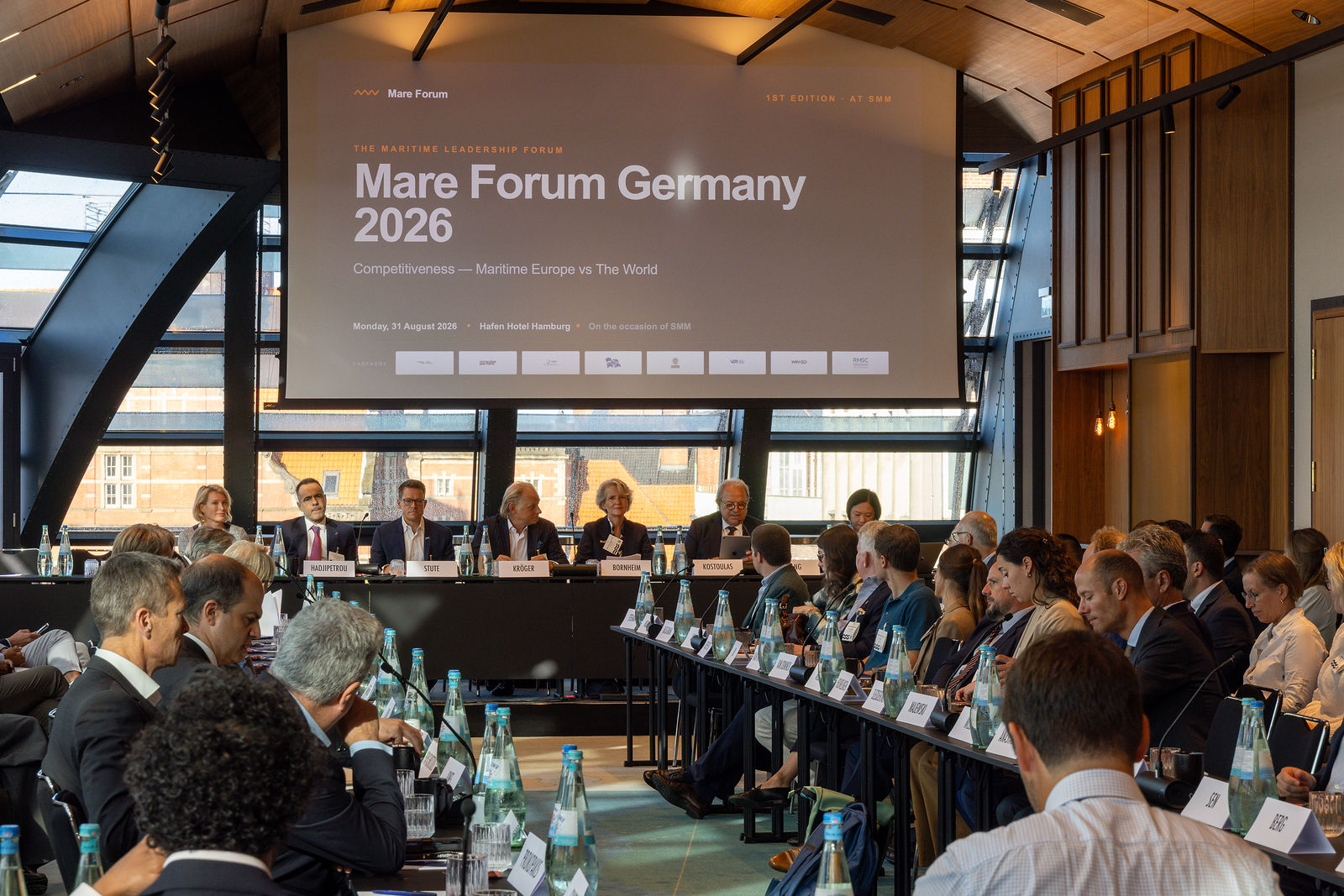
Hamburg, 31 August 2026 — On the eve of SMM, more than fifty owners, bankers, shipbuilders, port chiefs, insurers and policymakers spent a day at the Hafen Hotel on one question: can maritime Europe still compete? The answer, across eight sessions of the 1st Mare Forum Germany, was a qualified yes. But only if Europe recycles the billions it now takes from shipping, gives investors a rulebook that outlasts an election cycle, and learns to speak with one voice.
The opening shot
VDR president Gaby Bornheim set the tone within minutes. Ship owners, she said, do not wake up asking for a new strategy. They ask where cargo will move, whether they can insure the route, where they will find fuel, and whether they can still operate from Europe.
The Commission’s new maritime industrial and port strategies are “welcome” — Brussels has finally understood that shipping is Europe’s supply line. But “strategy is only as good as the business decisions it changes.”
Her central charge: Europe regulates the demand for green shipping — ETS, FuelEU, reporting, penalties — while the fuels do not exist at scale. Shipping now generates roughly €9 billion a year through the ETS. “A meaningful share must return to shipping,” or Europe has simply created a green shipping bill that its own owners pay and their competitors do not.
“Without ships, Europe’s strategic autonomy is a PowerPoint presentation.”
Gaby Bornheim, President, VDR
On the IMO she was unambiguous: slow, frustrating, compromised — but global shipping means global rules. On protectionism: “You cannot make European shipping competitive by forcing it to buy more expensive ships, equipment or fuel.”
Conference chairman Martin Kröger framed the day with R.E.M.: it may be the end of the world as we know it. Every generation of owners has been told that, and every generation has adapted.
The numbers
ECSA secretary general Sotiris Raptis put figures on the anxiety. European owners controlled about 40% of the world fleet six years ago; today it is 34.5%. Yet they account for 44% of the order book for ships able to run on sustainable fuels, often paying a 30% premium. The investment is there. The fuel is not: only about 10% of alternative-fuel projects are in Europe, against 74% in Asia.
His prescription had four parts. Keep the tonnage tax regime the Commission has now endorsed. Reject protectionism. Recycle ETS revenue — the Commission has earmarked some €10 billion for fuels and wants member states to spend half their ETS take on fuels and technology. And, his sharpest point, put a supply mandate on fuel producers. Shipping is “the only sector of the European economy without a requirement on fuel suppliers.” Aviation and power both have one.
Columbia Group’s Andreas Hadjipetrou added the ship-management view. Europe controls 35% of the fleet on 15% of global GDP, and 76% of EU external trade moves by sea. The officer shortfall is around 39,000 this year, with 22,000 more needed every year. Managers are paid $400 a day — the same fee as 30 years ago — while Asian rivals offer $200. Owners, he said, cannot demand safety, training and cyber resilience while choosing a manager on price alone.
INTERCARGO’s Dimitris Monioudis said Bornheim’s speech “sounded like Athens.” The dry bulk centre of gravity has moved to Asia because the cargo has. “Shipping still grows in Europe despite EU policies, and we should be honest about it.”
The green shift
DNV’s Rasmus Stute asked the room whether IMO net zero by 2050 is achievable. Three hands went up.
BRS’s Andrew Wilson played the pessimist. The IMO is “stuck in a rut” while the current US administration remains, and the gap between European and global rules “gets wider and wider.” A refining system moving 105 million barrels a day cannot be rebuilt in a decade. Conoship’s Jan Jaap Nieuwenhuis added the more worrying thought: owners have grown comfortable with the slowdown. “When he’s gone, we’ll have lost speed.”
Yet one opportunity recurred all day: Europe’s short-sea fleet as a laboratory. Peter Molloy of Sea3R noted that 80% of northwest European and Baltic coasters never leave the region, trade until they are 40 years old, and serve large European corporates rather than one-voyage traders. That is the ideal setting to prove fuels, wind propulsion and supply chains at low capex before scaling to deep sea. The ETS cut-off below 5,000 gt, he said, “stopped the regulation just before it got interesting.”
The momentum loss is measurable. WinGD reported that dual-fuel two-stroke orders had swung from roughly 75% alternative-capable to 75% conventional after the IMO postponement. Prow Capital’s Gust Biesbroeck argued the answer is locking in corporate customers for green corridors, not waiting for freak rates: “We don’t need $600,000 a day to make wind-assisted shipping work.”
“The facts are moving faster than the beliefs.”
Tom Kleppestø, Oslo Shipowners’ Association
Two regulatory gaps surfaced. Value Maritime’s Michela Bassignani asked whether captured CO₂ is waste or commodity — nobody has decided. FuelsEurope’s Tiphaine Angla pushed back on a fuel mandate: producers already have projects at FID; what stops investment is that “rules change with every policy cycle.” Nuclear split the room: bankable only with a long-term customer and global port acceptance, and think hard about the residual value of a 40-year-old reactor ship.
The industrial base
VSM’s Reinhard Lüken rejected the “last battle” framing. Europe still leads in complex ships and its capability base is “probably incomparable globally.” What China has is political will. Europe writes strategies — “who remembers the Lisbon strategy?” — and does not implement them. Japan has just decided to double output with state money. The US built under 100,000 gt last year; Europe built 2.5 million.
“China decided in 2002 to become number one. Europe was three times as big. It can be done.”
Reinhard Lüken, Managing Director, VSM
The most concrete data came from Conoship. The Netherlands still leads global shipbuilding up to 3,600 gt, competes to 6,500 gt, and loses to China at 8,500 gt. Northern Dutch yards launch some 20 short-sea ships a year, with full books to 2030 and no subsidy. A Dutch-built ship is 150–200 tonnes lighter than its Chinese equivalent, because Chinese yards insist on Chinese suppliers.
What killed recent European series orders was not price. It was the absence of refund guarantees and the 10-year finance Chinese yards offer. The ask is finance instruments, not subsidies. “How did the Netherlands build its railways? Hundred-year loans.”
EDR Antwerp Shipyard CEO Stijn Van Doninck described the Antwerp repair cluster collapsing from 15,000 workers to 60 before its revival, and asked why a Norwegian-financed, European-designed vessel was still built in Asia. Dutch Boat Factory’s Hilmar Backer pitched 3D-printed hulls as re-shored, circular manufacturing — if classification catches up. Smart-Ship founder Roy Kok said Chinese officials had walked into his office offering premises, funding and test water; in the Netherlands a €200,000 grant takes months.
“I don’t need good policy or bad policy. Predictable policy would be the best policy.”
Roy Kok, Founder, Smart-Ship
SEA Europe’s Christophe Tytgat closed the loop: the strategy’s 70-plus actions are non-binding, and DG GROW’s new Maritime Industrial Value Chain Alliance puts the burden back on industry to bring business cases.
Money
Michiel Steeman’s finance panel described a lender’s market turned buyer’s market. Pricing has collapsed across corporate, non-recourse and family-owner lending, and the spread between them has narrowed. DekaBank’s Marco Albers was blunt: banks are not pricing too low, cash-rich owners are squeezing them — “either you follow or you lose the business.” Frontline repriced $2.5 billion by 52 basis points in six months.
Seahawk’s Michael de Visser countered that banks should sit on their hands and keep capital for the correction. NorthCape’s Jerzy Majewski sized Chinese leasing at $150 billion across some 25 houses, “not yet tested in a downturn.”
On the Poseidon Principles, KfW IPEX’s Tanja Georg defended them as a transparency signal. DNV’s data was harder: portfolio carbon intensity falls 2–3% a year while the trajectory demands 4% or more, so signatory banks “look worse every year.” Almost no newbuilding today meets the 2030–35 targets, because the regulator has not followed. One concrete ask emerged: ECB capital relief for Poseidon-aligned loans.
The consensus: not a lack of capital, a lack of bankable projects. Banks cannot take venture risk at bank prices without a value-chain approach and government de-risking.
People
Phrixos Papachristidis’s people panel was the day’s most human. Columbia keeps about 70% of its cadets through to senior officer. Greece’s academies take 1,800 from 12,000 applicants and retain 400. Germany’s six-week summer sea programme for 16- to 18-year-olds takes 80 a year and has lifted German seafarer intake 30% since 2012 — to 500 a year.
OKEE Ship Management’s Dmytro Chekhovskyy, a former master, described nine months without crew change during COVID, then discovering that “good captains are not needed ashore.” An apprentice, Lucas, delivered the line of the day: he found ship management by accident on a jobs site, his school’s career guidance had never mentioned shipping, and his classmates joined for the pace and the internationality, not the money.
“You’re talking about the future, and I’m the only young person in the room. Go ask your kids what they want.”
Lucas, apprentice, ship management
Dan Jespersen of 7C Shipping brought a court ruling: a master’s systemic errors rendered a ship unseaworthy. Crew mental fitness is now a seaworthiness and general-average issue, not just a welfare one. Daniel Jones of Noorden Jones confirmed the defence: due diligence in recruitment, training and shore support. A valuer added that management quality is starting to appear as a risk note on valuation certificates. Lenders admitted they do not price crew, but “it’s the crew that protects our collateral.”
Cyber
DNV Cyber’s Annika Nevaste framed the digital thread in her keynote. Most vulnerabilities now sit in the supply chain, not the company. “The first victim is rarely the last.” Compliance with NIS2 and the Cyber Resilience Act “does not create resilience” — trust does, and trust is becoming a competitive differentiator.
“Are we becoming digital faster than we are becoming resilient?”
Annika Nevaste, CEO, DNV Cyber
The afternoon panel, moderated by Bureau Veritas’s Panagiotis Anastasiou, opened with a show of hands. Incidents have doubled in a year — who doubled their cyber budget? One hand. HHLA’s Johannes Berg described hundreds of millions invested in remote-controlled cranes and automated vehicles, and accepted that every step of automation widens the attack surface. Port of Rotterdam’s Oscar van Veen described an internal “AI squad” with more than 100 agents, and a deliberate choice of knowledge-graph AI over hallucination-prone language models wherever a system talks to a ship.
Astaara’s Philip Ponsford delivered the session’s verdict on insurance: maritime cyber cover is “a lawless hellhole of uncertainty.” Mainstream underwriters exclude cyber because they do not understand it, and the buy-backs that exist “aren’t worth the paper they’re printed on.” Ninety per cent of incidents are human error; the fix is culture from the board down. Print the incident plan — in 2017 Maersk could not print anything. The moderator added that BV sees two or three undisclosed incidents on vessels every day.
Ports
The closing session, moderated by INTERCARGO, accepted that European ports are now targets in a hybrid-war environment. FEPORT’s Lamia Kerdjoudj described the shift from just-in-time to “just-in-case,” and a new “co-opetition” between Rotterdam and Antwerp on security.
The sharpest exchange came from the floor: can a municipal port company carry NATO-level preparedness expectations? Port of Oslo’s Ingvar Mathisen was clear — if the nation wants ports to serve defence, the nation must fund and mandate it. FEPORT added that public money is no longer growing, so the only model left is one that attracts private capital.
“We cannot expect a port owner to do something that is not serving the city.”
Ingvar Mathisen, CEO, Port of Oslo
KVNR’s Lodewijk Wisse pushed back at the regulators: investors are eager, but assets last 25–50 years and the rulebook changes every five. Rotterdam’s vice mayor Tim Versnel answered with belief in the continent — warm but, by his own admission, not a business case. He was more concrete on space: Rotterdam is preparing a study to convince “lawyers and judges” that the port must physically expand. And he turned on his own sector: maritime, unlike ASML, is “too fragmented” to pitch effectively in The Hague or Brussels.
Port of Oslo offered the counter-example — 30% growth targeted and 85% emissions cut by 2030 on half the historical port area. The day’s most practical warning came on fuels: ports will need to bunker three or four fuels in parallel, each needing separated space, and Hamburg, Oslo and Rotterdam have none to spare.
Versnel closed the day: “The success of my neighbour is my success.”
Outtakes
- “That is not global leadership. That is unilateral cost creation.” — Gaby Bornheim, on FuelEU
- “Ships cannot be run on regulations.” — Gaby Bornheim
- “The car makers had exactly this discussion fifteen years ago.” — Sotiris Raptis, ECSA
- “Who remembers the Lisbon strategy?” — Reinhard Lüken, VSM
- “Go to your bank and say you want to triple your output — you won’t even get a coffee.” — Reinhard Lüken
- “Subsidies are drugs. You get addicted.” — Mare Straetmans, Platform Zero
- “Standing alone in the rain.” — DNV, on Poseidon banks versus regulators
- “We’re selling nostalgia — the grey man with a moustache on the bridge.” — Tije Vos, VSTEP
- “Ask my crane drivers to prompt an agent for 30 minutes a day and they’d tell me to buy them a beer and get therapy.” — Johannes Berg, HHLA
- “The Dutch still like to live in fantasy land.” — Tim Versnel, City of Rotterdam
- “What do we think about India?” — Lodewijk Wisse, KVNR (the question nobody answered)
Action plan
For Brussels and member states
- Recycle the ETS. Bind a minimum share of the roughly €9 billion a year to maritime fuels, port infrastructure, training and cyber — and publish where it goes.
- Mandate fuel supply, not just fuel demand. Extend supplier obligations to marine fuels, as in aviation and power.
- Sunset regional rules on global agreement. Withdraw the FuelEU/ETS overlap once an IMO framework enters force, so European ships do not pay twice.
- Finance, not subsidy, for yards. EU-level refund guarantees and long-tenor loans for shipyard capacity; treat yards as strategic infrastructure.
- Predictability as policy. A ten-year maritime regulatory roadmap that survives election cycles.
- Fix port governance before demanding preparedness. National funding and explicit mandates for defence-readiness at municipal ports.
- Capital relief for green lending. An ECB/EBA risk-weight incentive for Poseidon-aligned loans.
For the industry
- One voice. A standing owners–yards–equipment–ports coalition, using the new Maritime Industrial Value Chain Alliance, bringing business cases rather than position papers.
- Use short-sea Europe as the test bed. Prove fuels, wind and carbon capture on coasters that never leave the region, then scale.
- Pay for management. Value managers on total performance, not the $400-a-day fee.
- Treat crew fitness as seaworthiness. Board-level welfare KPIs, mental-health support in due-diligence files, shore-to-sea career paths.
- Visibility campaign. Every executive gives one school or college talk a year; expand the German 16–18 sea-internship model EU-wide.
- Cyber as a board KPI. Tabletop exercises with legal and communications present; incident plans held off the network; standard cyber-insurance definitions that include GPS interference.
- Share insights, not data. Trusted data safe-houses with competition-safe governance.
Photos from the day are in the Hamburg 2026 gallery. Quotes are from session recordings and lightly edited for clarity.